Friday, 20 December 2024

A Southern Christmas 2001 - Day 5 (first view of the ice)

Please remember, if you're reading this for the first time, stop and go back to the beginning HERE.

Otherwise welcome to Day 5 on our Antarctic saga...

Thursday 20th December 2001

at sea (61 deg S, 125 deg E)

We’ve had the smooth and now we’re getting the rough. It is as if having been granted smooth passage through the furious fifties, we’ve had to make up for it in the shrieking sixties. We crossed the 60th parallel at about 1230 and the barometer fell rapidly.

The big excitement of the day, however, was the iceberg sighting. The first one was spotted this morning at 0230, which ended the ice raffle and raised $150 towards Camp Quality when Ian, one of the meteorologists on the way south for his fifth winter donated his prize. However, since it was at half-past two in the morning, not many people other than Jake the second mate who was on watch at that time, were able to see it. It wasn’t until a little later that morning that we got to see the object for which we had all been waiting.
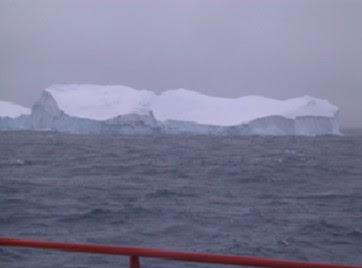
At about 10 am, a bunch of us were clustered around the bridge when the skipper drew our attention to a blip on the radar about 10 miles dead ahead of us. As we got closer, it loomed out of the mist on our starboard side. It was a monster, looking like a big white rocky island with cliff faces on all sides and waves breaking against it. It was at least 40 or 50 times the size of the ship, like a massive silvery-blue Gibraltar drifting ever so slowly in a northerly direction. It was so close that we could make out the discolouration from some organism, algae maybe, on its upper parts. It was a spectacular introduction to this great south land and filled us all, especially the first trippers with great anticipation of what was to come. We saw another two or three as the day wore on, although most of them were too far away to see their features and were nothing like that first spectacular sight.
After this, the weather deteriorated and by later afternoon we were heading into the teeth of a strong gale with winds of 35 to 45 knots and six to eight metre waves crashing over the bow and occasionally going straight over the top of the bridge. By early evening, our speed was down to six or eight knots as we diverted course slightly further south-south-west to get into the sea ice earlier and provide some calmer conditions.
This would be a good moment to mention the ship’s bridge and the attitude that the officers and crew of Aurora have toward the expeditioners. The bridge is without a doubt the congregation point; and all the officers and crew without exception, make their passengers welcome throughout the voyage. As an old ship’s engineer in a former life, I will always remember that the engine room is the real heart of a ship. This is where you will find the thrust and the muscle and the energy needed to get us to our destination – but the bridge is where the decisions are made; where the eyes and ears see, and the voice communicates. Little wonder that during my own sea days, I would spend as much time that I could on the ship’s bridge, rather than down below in the artificial light of a hot and noisy engine room.
Captain Tony Hansen has been a most gracious and informative host to us all. No question is too inane or pointless and no request for information is too much trouble to answer. Yet throughout this his officers and crew go about the task with an air of professionalism of which the ship’s owners and the Australian Antarctic Division can be justifiably proud.
I haven’t had a chance to talk more about the scientists today. Angela is our krill expert who will be collecting them as we approach the ice edge. Tonight’s krill fishing has been postponed due to the poor weather – more about this tomorrow.


Thursday, 19 December 2024

A Southern Christmas 2001 - Day 4 (still at sea en-route to Casey)

A reminder - if you've never seen this before, please go HERE to read the Introduction and Day 1 - otherwise, read on...

Wednesday 19th December 2001

At sea (57 deg S, 130 deg E)

The weather deteriorated slightly, although we are still getting a relatively smooth passage as we continue our south-westerly course. At noon today, we were about halfway to our destination, nearly 1,000 nautical miles (1,875 km) from Hobart and another 1,000 to go. 

We are now at 57 degrees South latitude and the sea temperature is down to about 3 degrees C, about a degree below the outside air temperature. The wind has swung to the northeast as we skirt around the eastern edge of a huge weather depression to the west of us. The barometer has dropped to 975 HPa and visibility is down to about 250 metres, but we are still making good time at 16 to 17 knots. Here ends the meteorological report.

Today’s training session was on survival. Voyage Leader Greg, a mountaineer and training consultant in his other life, gave us an excellent demonstration on the use of the Bivi Bag which is like a huge sack made from weather-proof material (not waterproof since it never rains in Antarctica). The word "bivi", of course, comes from bivouac, for which we should always be prepared even if only a few tens of metres from camp.

I have previously mentioned the number of scientists on board, and over the last couple of days Yann and I have had the chance to understand what it is that they do and their passion for their specialist fields. For example, John, a zooplankton biologist, has been streaming a Continuous Plankton Recorder (CPR) from the stern of the ship ever since we left Hobart. The CPR catches plankton in a type of Swiss roll material which sits about ten metres below the surface and which slowly but continuously winds itself on as we move south. When it gets to the end of the roll, as it did this morning he collects and counts the plankton and records where it was collected, thus providing a record of plankton abundance between Tasmania and the Antarctic shelf.

Another of the scientists on board this trip is Steve from the University of New England who has been counting the large kelp rafts that drift past the ship. This helps in providing data to determine the potential for the dispersal of kelp-associated organisms. For a long time, scientists have questioned why islands such as Macquarie Island and other sub-Antarctic land masses like Heard Island, although many millions of years different in their ages, and over 5,000 km apart, have similar fauna. Steve’s work, plays a valuable role in providing a better understanding of the importance of that circumpolar currents play in the distribution of organisms across the Southern Ocean. This in turn, of course plays a significant part in contributing to a better understanding our planet’s health.

Tonight we were provided with our rosters for Casey, where, if present conditions prevail, we will arrive mid-afternoon on the December 22, (our Christmas Day). We also learned that King Neptune is due to pay us a visit on Friday afternoon to seek retribution from all those first-timers who have dared to cross the 60th Parallel without his permission. 

It remains to be seen what this holds in store for us. 

Until tomorrow...

Wednesday, 18 December 2024

A Southern Christmas 2001 - Day 3 (still at sea - training day)

 If I may repeat yesterday's comment: please go back and start (HERE) if you have not yet read the introduction to this series - otherwise read on and enjoy, as we get into Day 3 of the great southern adventure...

Tuesday 18th December 2001

At sea

It's a superstition at sea never to talk about how fair the weather is, otherwise the sea gods may take it away. This is just one of many little chestnuts like whistling up the wind (which is either bad luck if it brings bad weather, or good if it brings much needed wind and you're in a sailing ship) and sighting an albatross (which also works both ways).  

Per Hansen, Aurora's archetypal Danish bosun, (more correctly these days, Senior Integrated Rating) reminded me of this when he overheard me saying that the sea could easily be mistaken for the Mediterranean at its best.  Nevertheless, the weather could almost be described as balmy and we are making 17 to 18 knots in a gentle swell and a light westerly breeze which could almost be called a zephyr – and this is at 53 degrees South latitude which is well inside the furious fifties. I’m not going to write any more about the weather today in case Per is right.

We received a message from Antarctic Division today giving us, and all other staff at AAD an update on the voyage schedules of Aurora and one of her sister ships, Polar Bird which is on a supply trip to Mawson. Polar Bird is not an icebreaker, she’s regarded as ice-capable, and she has been stationary in heavy ice conditions in Prydz Bay for about 12 days. Polar Bird is apparently in no danger and is accessible by helicopter, but at the moment she is beset.

If the situation with Polar Bird continues, a decision will be made after our arrival at Casey whether Aurora is to be re-routed to assist. Although there are not yet plans to do this, we are taking advantage of the fair weather (sorry, prevailing weather conditions) to travel at optimum speed to Casey thus providing an opportunity to divert if needed.

Interest in the Ice Sweep is growing, with some pundits wagering that it will be as early as tomorrow night when we see our first berg. Proceeds from the raffle will go to Camp Quality, the charity adopted by the officers and crew of Aurora which provides great benefits and opportunities to under-privileged kids. As I wrote yesterday, the iceberg must be at least as big as the ship, the sighting must be independently verified and under no circumstances are we to bribe the captain or any of the officers to use the radar or alter course in any way. I’m punting for Thursday mid-morning.

Today's training was on clothing and the risk and avoidance measures for hypothermia and frostbite. Although much of this is aimed at the winterers and the researchers who will be working away from the base station, the training is essential for all who travel to the Antarctic and is a reminder that this is not just another trip to the seaside. There is talk of additional training in abseiling down on to the ice from the deck of the ship later on in the voyage as part of crevasse safety training - something to get excited about!

I continue to be in awe of the work done by the scientists on board and their commitment and devotion to the job they are doing in understanding the part this corner of the world plays in the whole global life cycle. Little wonder there is so much enthusiasm in keeping this place pristine and unsullied by humanity's frequent appetite for destructive exploitation.

More tomorrow...